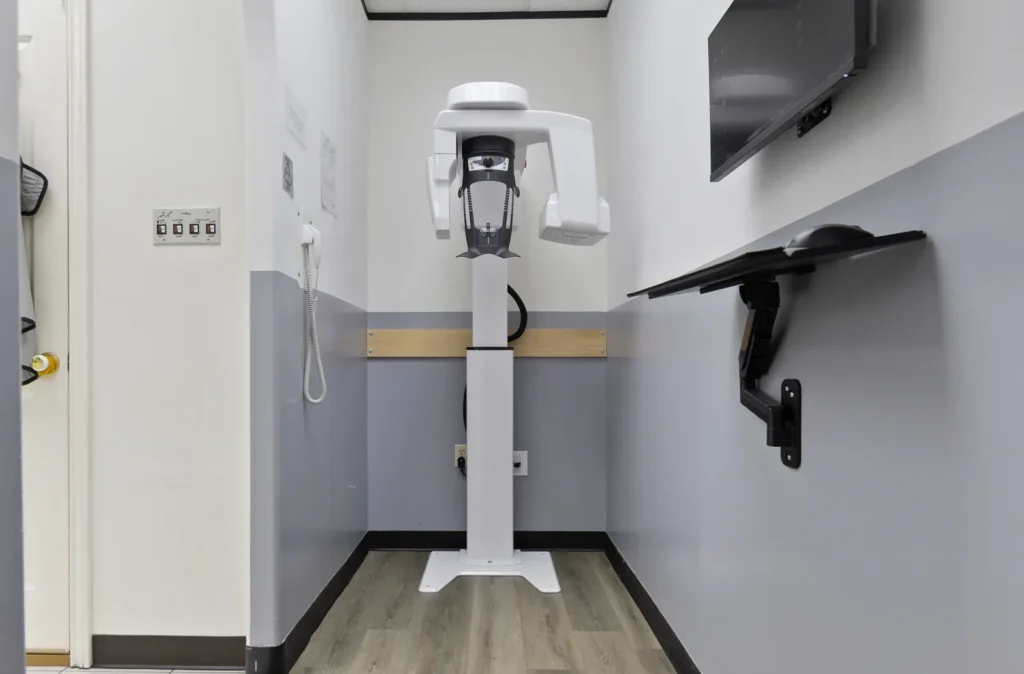
Panoramic X-Rays in Houston, TX
A panoramic X-ray gives a wide view of your entire mouth, including your teeth, jaws, and sinuses. Unlike regular X-rays, it doesn’t show small cavities. Instead, it helps find bigger problems like impacted teeth, bone problems, infections, and cysts. At Next Care Dental Houston, Dr. Patel and Dr. Vu use panoramic X-rays in Houston, TX, for accurate dental diagnosis and treatment planning.
Request An Appointment
What Does a Panoramic X-Ray Show
Panoramic X-rays offer a wide view of your mouth, helping our dentists identify many dental issues. We use them to check for the following:
- Problems with implants, braces, or dentures.
- Jawbone issues like fractures or inflammation.
- Cavities and tooth decay.
- Gum disease.
- TMJ problems.
- Wisdom teeth issues, including impactions.
- Cysts and other abnormalities.
Because panoramic X-rays don’t require anything to be placed inside your mouth, they’re a great option for people with sensitive gag reflexes.
Not only that, panoramic X-rays are an advanced imaging technology that helps our dentists create effective treatment plans for a variety of dental concerns.
How We Take Panoramic X-rays
At our Houston dental clinic, we offer panoramic X-rays.
Panoramic X-rays take a full picture of your teeth and jaw. Our panoramic X-ray machine rotates around your head to capture detailed images that help our dentists spot potential problems like wisdom teeth issues, bone abnormalities, or infections.
Unlike traditional X-rays, which focus on individual teeth, panoramic X-rays give a complete overview of your oral health. This helps our dentists diagnose problems early and create the best treatment plan for you.
These X-rays are comfortable and quick, and there’s no need to bite down on anything, as the X-ray film is part of the machine itself. Our dental experts may recommend a panoramic dental X-ray as part of your regular dental checkups to ensure optimal oral health.
Question About Panoramic/CT Scan
How Often Should You Have a Panoramic X-Ray
Panoramic X-rays aren’t part of your regular dental checkup. When you visit our clinic for a routine cleaning and exam, we’ll typically take standard X-rays to check for cavities and gum disease. These X-rays are called bitewing and intraoral X-rays.
Our dentists only use panoramic X-rays when they need a more detailed look at your entire mouth. This might be necessary if you have symptoms such as jaw pain or difficulty chewing or if they suspect any wisdom teeth problems.
Our panoramic imaging services in Houston can also help our dental team plan treatments like braces or dental implants.
What People Say About Us!
Let Us Examine Your Oral Health with Panoramic X-rays
We use the latest technology to provide top-notch dental care. Our advanced panoramic X-rays give our dental professionals a clear picture of your entire mouth, helping them find problems early. This means we can offer you the best possible treatment plan.
Want to learn more about panoramic X-rays in Houston, TX? Our experienced dentists are here to help. Call us at (713) 952-0522 or book an appointment online today.
I have a very strong gag reflex; is a panoramic X-ray easier for me?
Yes, absolutely! This is one of the biggest benefits for our patients who struggle with traditional X-rays. Unlike “bitewing” X-rays, where you have to hold a sensor inside your mouth, a panoramic X-ray is completely extraoral. You simply stand or sit still while the machine arm rotates around the outside of your head. There is nothing placed in your mouth to bite down on, making it a stress-free experience for anyone with a sensitive gag reflex.
Why do I need a panoramic scan if I don't have any tooth pain?
Panoramic scans are “preventive detectives.” They show us things that standard X-rays can’t reach, such as the health of your jawbone, the position of your sinuses, and any hidden cysts or tumors that might be growing without symptoms. At our Westheimer office, Dr. Patel and Dr. Vu use these scans to catch “silent” issues early long before they cause pain or require major surgery.
How does a panoramic X-ray help with my wisdom teeth evaluation?
Standard X-rays often can’t see the full length of a wisdom tooth or its relationship to the surrounding nerves. A panoramic X-ray provides a wide-angle view of your entire jaw, showing exactly how your wisdom teeth are positioned. This helps us see if they are “impacted” (stuck in the bone), if they are pushing against your other teeth, or if their roots are too close to the primary nerves in your lower jaw.
Why is this scan necessary before I get dental implants or braces?
Precision is key for a successful result. For dental implants, we need to know exactly how much bone density you have and where your sinus cavities are located to ensure the implant is placed safely. For braces, the scan helps us see the alignment of all your teeth and their roots in relation to each other. It’s the “blueprint” that allows Dr. Vu and Dr. Patel to create a safe and effective treatment plan tailored to your unique anatomy.
Will I need to stand still for a long time during the panoramic scan?
Not at all. The process is very quick, usually taking less than 20 seconds for the machine to complete its rotation around your head. Our team will help you position your chin on a small rest to keep you steady. It’s a fast, painless, and “open” experience, so you won’t feel crowded or claustrophobic during the scan.
Can a panoramic X-ray detect issues like TMJ or jaw fractures?
Yes, it is one of the best tools for diagnosing jaw-related issues. Because the scan captures the “temporomandibular joints” (TMJ) and the entire mandible (lower jaw) in one image, it allows our dentists to see signs of inflammation, alignment issues, or even tiny fractures that wouldn’t show up on a small, localized X-ray. If you’ve been experiencing jaw clicking or pain, this is often the first diagnostic step we take.
Is the radiation level higher for a panoramic scan since the machine is larger?
Surprisingly, no. Even though the machine looks larger, modern digital panoramic technology is highly efficient. The radiation exposure is very low often comparable to the amount of natural radiation you’d receive during a few hours in the sun. We are committed to your safety at Next Care Dental and only recommend these scans when they provide a clear benefit to your diagnosis and treatment.